Nội Dung Chính
Selling educational material online has a quiet weak spot. A tutor with revision notes, a small publisher pushing textbook bundles, a teacher who sells worksheets from a personal site: all of them rely on people finding their pages through search, and all of them tend to assume the pages are still where they were last month. Paid ads can cover some of that gap, but organic positions only help if somebody keeps an eye on them.
The usual way of keeping an eye on them is a spreadsheet and a lot of patience. This piece looks at that habit next to this lightweight keyword position checker, and asks a narrower question than most reviews do: for a small education seller, when does the manual routine stop paying for itself?
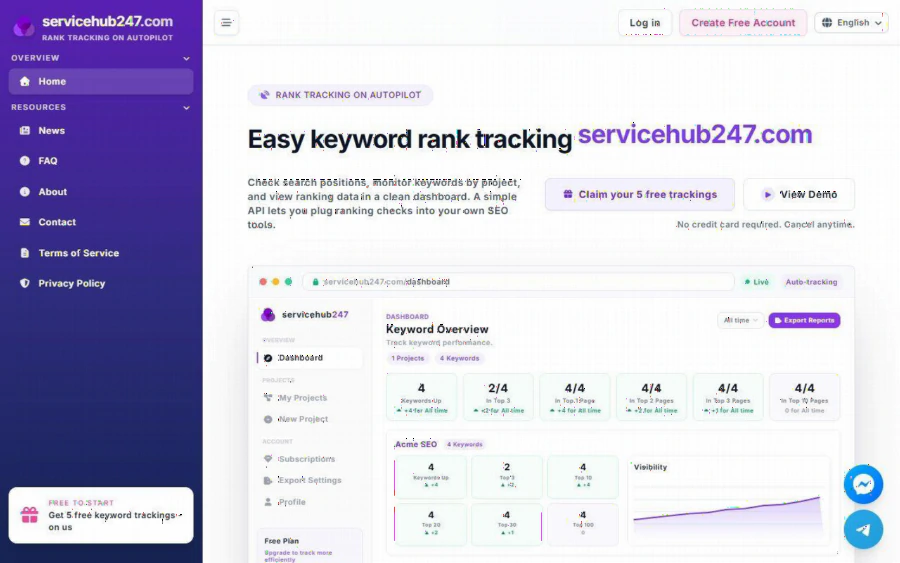
The ServiceHub247 demo dashboard showing a sample project with summary counters for keywords moving up and landing on page one
One tutor and a list of thirty phrases
Take a freelance chemistry tutor who runs a modest site. It has chapter notes, a blog about choosing textbook editions, and a small search ad budget. She keeps a list of thirty phrases: a few broad ones, many specific to single chapters, and some about particular books. What she wants to know is simple. Which pages climbed since the last check, which fell, and whether her ads are buying clicks she would have received for free.
Her current method is to open a private browser window, type each phrase, count down the results, and write a number in a cell. Thirty phrases take most of an evening. The numbers also carry hidden noise. Results differ by location and by what the browser remembers, so each figure is one reading from one place at one moment. After a month she has a tidy grid and no confident way to tell whether a two place move means anything.
What the tool does, in plain terms
ServiceHub247 calls itself rank tracking on autopilot. You create a project, give it your site address, paste in the phrases you care about, and pick a search region. From then on the system checks positions on a schedule and refreshes the table without you reloading it. The site says fresh keywords need a short wait before their first data appears, so do not panic if a new project looks empty for a few minutes.
The main screen summarizes a project with counters for how many phrases improved and how many sit in the highest result bands. Underneath is a table showing where each phrase started, where it is now, how it changed over a day, a week and a month, and which of your pages is the one ranking. The demo uses a made up project called Acme SEO, so read its numbers as a picture of the layout and not as proof of anything.
Around that core are trend charts, a stored history for every phrase, alerts, exportable reports with a PDF snapshot, a morning summary of what moved, some domain strength metrics, and an API for feeding checks into your own tools. The site does not say which search engines other than Google are covered, how many regions exist, or where the domain metrics come from. Those are worth asking about before you rely on them.
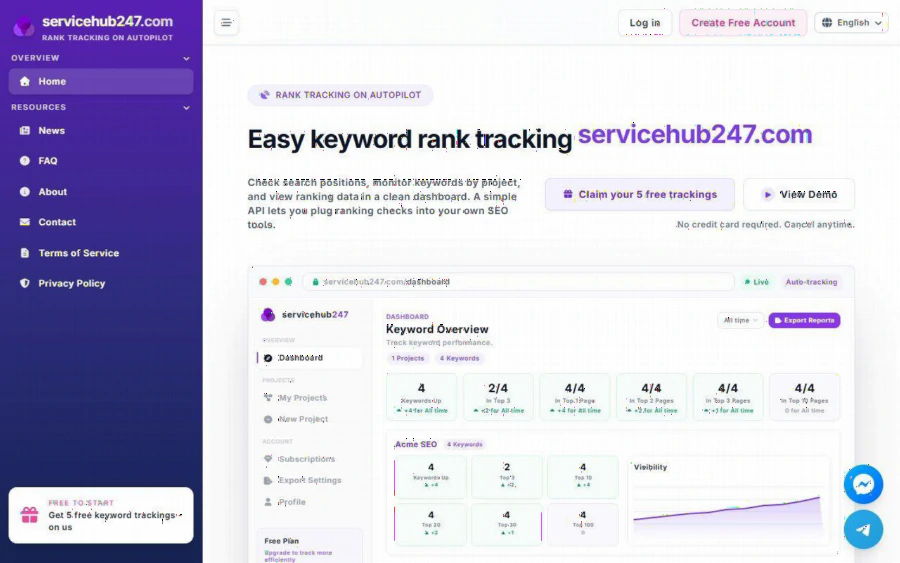
A keyword table from the demo showing starting position, current position, short and long term changes and a log of past checks
Where a spreadsheet really does fall short
The honest comparison is not tool against laziness. A spreadsheet is free, flexible and fully yours. If you track five phrases and check them monthly, it is a perfectly reasonable choice, and a paid product would add little.
The trouble starts as the list grows and the rhythm tightens. Consistency is the first casualty. A scheduled check from a fixed region produces numbers that can be lined up against each other, while hand checks wander. Memory is the second. The demo shows a record of thirty one checks for a single phrase, which is the sort of trail nobody maintains by hand for thirty phrases. When the tutor's chapter page slips, she can match the date of the drop to the date she rewrote the page. Without that trail she is guessing.
The third casualty is attention. A morning summary or alert arrives whether or not she feels like opening anything. Spreadsheets only help when you remember to feed them, and in my experience that lasts until the first busy exam week. The site does not explain how alerts are delivered or how sensitive they are, so treat that part as something to test.
What it costs and what the limits are
The published plans are easy to summarize. A free tier covers five phrases checked weekly with no end date. A weekly paid tier for thirty phrases is listed at $5.90 a month, and the next one up, for fifty phrases, at $7.90. Moving to daily checks raises the price sharply: thirty phrases at daily frequency is $21.90 a month. Larger needs go to an individually quoted enterprise plan.
For the tutor, weekly checks on thirty phrases fit the lowest paid step. Daily checks on the same list cost almost four times as much, and for revision notes that probably is not worth it, since exam season moves traffic far more than day to day wobble does. A site in a fast moving niche might see it differently.
The ceilings matter too. Fifty phrases is the top of the self serve range as listed, so a publisher with hundreds of titles would have to talk to sales. The free tier is enough to test the habit and not much beyond that. And the site offers no side by side comparison with competitors, so any claim that it is better than a larger platform would be mine alone, not something the product supports.
Where it sits among the alternatives
Bigger SEO suites usually bundle tracking with site audits and link data. If you already pay for one, its built in tracker costs nothing extra, and a second login mostly adds clutter. If your needs are narrower, meaning positions, history and a regular summary at a small price, a focused tool is easier to justify. If you need huge keyword counts, many engines or deep integrations, read each vendor's documentation first, because the pages reviewed here promise none of that.
A practical way to decide
Skip the feature checklist. Take ten phrases and track them both ways for a few weeks, then ask three questions. Are the tool's numbers steady enough to trust? Did the history change anything you did with your pages or your ad budget? And did you actually read the summaries? If the third answer is no, no product, free or paid, will rescue the habit.
Nothing here promises a better position. Tracking does not move a page up a results list. What it provides is a dependable record, and for education sellers who split their time among content, ads and customers, a record that updates itself is a modest, real improvement over a grid that gets abandoned in week three.
Các Bài Học Khác

Slot game Ku3933 cụ thể như thế nào? Làm sao để người chơi có thể tham gia trò chơi giải trí này? Hãy cùng theo dõi ngay bài viết chi tiết dưới đây..
Xem thêm ⟶
Khám phá nổ hũ BJ88 với hàng nghìn game hấp dẫn và tỷ lệ thưởng cao. Tìm hiểu thêm về chuyên mục này qua bài viết sau đây của chúng tôi nhé!
Xem thêm ⟶